How long does it take to repair brakes? Read on to learn typical repair times for pads, rotors, calipers, brake fluid, and more, plus what can cause delays.
How long does it take to repair brakes?
For a routine brake pad replacement, a mechanic may finish the work in about one hour per axle.
If the job also requires rotors, brake bleeding, caliper work, or diagnosis of a larger problem, it can take several hours or longer.
The exact time depends on the vehicle, the condition of the braking system, the parts needed, and whether the correct replacement parts are available.
Someone searching for a 24 hour mobile mechanic may also wonder whether brake work can be done at the vehicle’s location.
Some repairs can be handled this way, while more complex jobs may require workshop equipment.
Knowing what affects repair time can help you plan your day and understand why one brake job may take much longer than another.
Typical Brake Repair Times
There is no single repair time for every vehicle.
Here are useful estimates for common jobs:
| Brake repair | Typical time |
| Brake inspection | 15–30 minutes |
| Brake pad replacement | About 1 hour per axle |
| Pads and rotors | Around 2–3 hours |
| Brake fluid bleeding | About 30–60 minutes |
| Caliper replacement | About 1–3 hours |
| Brake line repair | 1–3+ hours |
| ABS diagnosis | 1 hour or more |
These are general estimates, not guarantees.
Vehicle design and the condition of the parts can change the job time.
AAA notes that a standard professional brake pad replacement can often take about an hour per axle.
If rotors also need replacement or the brake lines need bleeding, the vehicle may need to stay longer.
How Long Does Brake Pad Replacement Take?
Brake pads are among the more common brake repairs.
A basic pad replacement usually involves:
- Safely raising the vehicle.
- Removing the wheel.
- Removing the old pads.
- Inspecting the rotor and caliper.
- Installing the new pads.
- Reassembling the brake.
- Checking the brake system.
- Testing the vehicle.
NHTSA repair documentation shows that proper brake service involves inspecting related components rather than simply removing old pads and installing new ones.
This is why a job advertised as a quick pad replacement can take longer if the inspection finds another problem.
What If the Rotors Also Need Replacing?
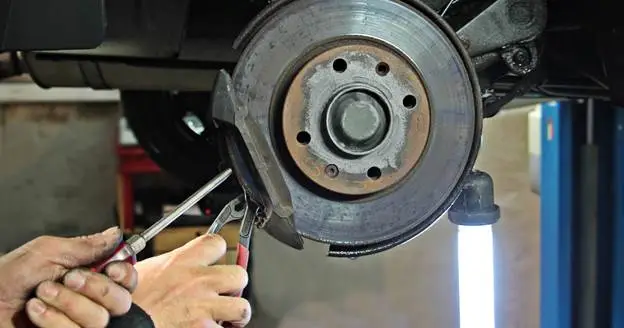
Replacing pads and rotors takes longer than replacing pads alone.
The mechanic must remove the old rotor, inspect the surrounding components, install the new parts, and complete the required checks.
AAA estimates that brake pad and rotor work may take two to three hours, although the exact time varies by vehicle and repair conditions.
Rotors should not be replaced just because the brake pads are worn.
Their condition and thickness should be checked against the vehicle’s specifications.
NHTSA service information shows that brake components have specific inspection and replacement limits.
How Long Does Brake Fluid Repair Take?
Brake fluid work can mean different things.
If the system only needs bleeding, the job may be relatively quick.
But if there is a leak, damaged brake line, or failing hydraulic component, finding and fixing the source can take much longer.
A soft or spongy pedal can be a warning sign of a brake-system problem.
AAA recommends having this type of symptom checked promptly rather than assuming that bleeding the brakes will solve it.
Why Can Brake Repair Take Longer?
Several things can turn a short repair into a longer one.
Rust or seized parts
Older or heavily exposed components can be difficult to remove.
A stuck caliper, rotor, or fastener can add significant labor time.
Additional damage
Worn pads can damage rotors if they are left too long.
Consumer Reports notes that grinding can indicate the pad material has worn through and may have damaged the rotor.
The wrong parts
If the correct pads or rotors are not available, the repair may have to wait.
More than one fault
A brake problem can involve pads, rotors, calipers, fluid, lines, or electronic systems.
Finding the actual cause can take longer than replacing one visible part.
Can a Mobile Mechanic Repair Brakes?
Some brake jobs can be completed where the vehicle is parked.
A mechanic mobile mechanic service may be suitable for certain pad, rotor, caliper, or other repairs when the vehicle can be safely worked on at that location.
People searching for a mobile mechanic near me may be looking for this type of service.
However, not every brake repair should be performed outside a properly equipped workshop.
A complicated hydraulic fault, difficult diagnosis, or repair requiring specialized equipment may need a shop.
The priority should always be safe repair, not simply getting the job finished quickly.
Does the Vehicle Need to Stay at the Shop?
If the problem is limited to a routine pad replacement and the parts are available, the vehicle may be ready relatively quickly.
A longer visit may be needed when:
- Rotors require replacement
- Calipers are damaged
- Brake lines leak
- The system needs bleeding
- Parts must be ordered
- Rust makes removal difficult
- An ABS fault needs diagnosis
- Additional damage is found
OSHA advises that vehicle maintenance should follow manufacturer specifications and that defective vehicles should be repaired before being returned to service.
When Should You Stop Driving?
Do not focus on repair time if the brakes are unsafe.
Get the vehicle inspected promptly if you notice:
- A brake pedal that feels soft or unusually low
- Grinding noises
- A major loss of braking power
- A brake fluid leak
- Strong burning smells
- Severe vibration
- A brake or ABS warning light
- The vehicle pulling strongly when braking
AAA lists these types of symptoms as reasons for brake inspection and service.
If the vehicle has seriously reduced braking ability, arranging a tow can be safer than driving it to a repair location.
Conclusion
So, how long does it take to repair brakes?
A basic brake pad replacement may take around an hour per axle, while pads and rotors may take two to three hours.
More complicated problems can take longer because diagnosis, damaged components, parts availability, rust, and hydraulic repairs all add time.
The best estimate comes after the braking system has been inspected.
A good repair should focus on finding the actual problem, using the correct parts, and making sure the vehicle is safe before it returns to the road.